Pakistan’s New Auto Policy: Winners, Losers and the Fine Print
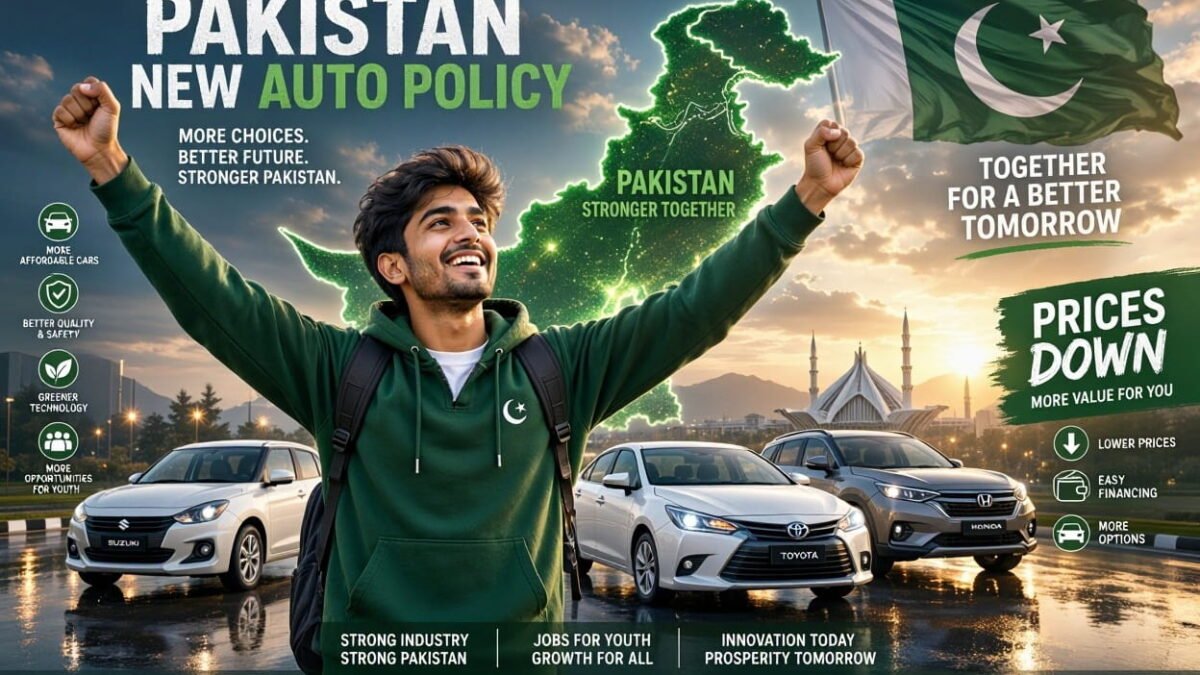
Islamabad: Pakistan’s Auto Policy 2026-31 promises cheaper small cars, big tax breaks for electric vehicles and a new levy on bigger engines. It also gives carmakers a blunt choice: export more and make more parts locally, or lose the duty concessions they have relied on for decades.
Information Minister Attaullah Tarar and Haroon Akhtar Khan, the Prime Minister’s Adviser on Industries and Production, unveiled the final draft in Islamabad on 7 November 2026. This report explains what is in it, who gains, who pays, and what still has to happen before buyers feel any change.
In this report
- What is the Auto Policy 2026-31?
- The six pillars
- Duty cuts on vehicles, parts and raw materials
- The new levy: who pays more
- Used car imports: no more age limit
- EV incentives
- Export targets and localisation
- Safety and buyer protection
- Winners and losers
- What critics say
- What happens next
- Questions people ask
Quick answer
The Auto Policy 2026-31 cuts duties on vehicles, kits, parts and raw materials over five years, exempts cars of 1,000cc or less from a new levy, and charges 2% to 10% on bigger petrol cars to fund EV and export incentives. Carmakers get concessions only if they meet export and local manufacturing targets. The policy still needs further approvals, including from the cabinet.
$6bnCumulative auto export target, 2026–31
0%New levy on cars of 1,000cc or less
Rs10mNew EV financing limit, up from Rs2m
20%Maximum advance payment at booking
What is the Auto Policy 2026-31?
Officially called the Automobiles and Auto Parts Manufacturing Policy 2026-31, it sets taxes, duties, targets and rules for carmakers, parts makers and importers until 2031. It works alongside the National Tariff Policy 2025-30, which is cutting import duties across the economy, and the New Energy Vehicles Policy.
The previous policy expired at the end of June. As a result, the industry operated without a fixed framework for more than four months, while the government negotiated with manufacturers, parts makers and the IMF.
The six pillars of the new auto policy
According to Radio Pakistan, Haroon Akhtar said the policy rests on six pillars:
- Affordable vehicles, especially for middle and lower-middle classes
- Boosting automobile exports
- Promoting electric vehicles
- Increasing localisation of parts
- Improving vehicle safety
- Ensuring transparency in the industry
He added that lowering the prices of vehicles below 1,300cc was a special focus of the Prime Minister.
Duty cuts on vehicles, parts and raw materials
Haroon Akhtar said duties on completely built-up (CBU) vehicles, assembly kits, components and raw materials would be reduced over five years. The government expects this to lower production costs, because nearly all of the industry’s raw materials are imported.
Under the framework the Prime Minister approved in September, customs duties move to a simpler four-tier structure of 0%, 5%, 10% and 15%. The weighted-average import tariff is set to fall from 15.7% to 5.99% by 2030.
“None of our raw materials are produced in Pakistan.”
— Auto parts industry representative, PAAPAM
That is why parts makers have pushed hard for cheaper inputs. Their association says the sector faces an estimated 34% cost disadvantage against regional rivals.
The Automotive Development Levy: who pays more?
To fund EV and export incentives, the auto policy 2026-31 introduces an Automotive Development Levy on petrol and other internal-combustion vehicles, both locally assembled and imported.
| Engine size | Levy | Examples of segment |
|---|---|---|
| Up to 1,000cc | Exempt | Entry-level hatchbacks |
| 1,001cc to 2,000cc | 2% | Most family sedans and compact SUVs |
| Above 2,000cc | 10% | Large SUVs and luxury cars |
| Buses and trucks | 2% | Commercial transport |
Legislation for the levy is targeted for December 2026, and the government is expected to bring a mini-budget to put it into law.
Used car imports: the age limit is gone
Strictly speaking, this change came through a separate decision, not the 7 November announcement. The Ministry of Commerce confirmed on 30 October that, under a decision approved by the ECC and the federal cabinet, the five-year age limit on commercial used-car imports was removed from 1 July 2026.
It forms part of the same reform package under the National Tariff Policy, which was agreed with the IMF. Imports must still meet safety, environmental and other import requirements.
The extra duty falls each year
An additional 40% regulatory duty on commercially imported used cars is being phased out:
- 2026-27: 30%
- 2027-28: 20%
- 2028-29: 10%
- 2029-30: 0%
Imports have already jumped. Government sources told ProPakistani that 2,276 used vehicles were imported in September 2026, against just 48 in May.
EV incentives: the biggest winners
- Tax exemptions: EVs priced up to $50,000 are exempt from capital value tax, withholding tax and federal excise duty.
- Sales tax: 1% on EVs, 6% on range-extended vehicles and 9% on plug-in hybrids.
- Financing: the EV loan limit rises from Rs2 million to Rs10 million.
- Charging: charging-station machinery gets zero customs duty and 1% sales tax.
- Target: the framework aims for EVs to reach a 30% share of new sales by 2030.
Export targets and local manufacturing
This is the policy’s biggest shift. Pakistan’s auto exports are currently worth about $200 million a year, and the new framework sets cumulative export targets of about $6 billion over 2026-31.
Each manufacturer will be given an export target. Those who meet it earn a reward worth 5% of export value in the first year, while those who miss it face penalties. Access to concessionary duties on assembly kits will also be linked to export performance.
Local value-addition targets for 2030-31
| Vehicle type | Local value target by FY2030-31 |
|---|---|
| Passenger cars | 40% |
| Light commercial vehicles | 45% |
| Tractors | 80% |
| Bikes and rickshaws | 90% |
| New energy vehicles | 15% |
Safety and buyer protection
The policy adds 45 safety standards for locally made vehicles, aiming to move them closer to international benchmarks. Officials pointed to defective brakes, tyre failures and non-working seat belts as factors in road accidents.
For buyers, the most immediate change is a cap on advance payments: manufacturers cannot demand more than 20% of a vehicle’s price at booking. Third-party audits will also be introduced to improve transparency.
Winners and losers of the auto policy 2026-31
| Group | Impact | Why |
|---|---|---|
| EV buyers | Big gain | Tax exemptions, 1% sales tax, Rs10m financing |
| Small-car buyers (up to 1,000cc) | Gain | Exempt from levy; duty cuts over time |
| Used-car importers | Gain | No age limit; regulatory duty falling yearly |
| Family-car buyers (1,001–2,000cc) | Mixed | Duty cuts, but a new 2% levy |
| Exporting manufacturers | Mixed | Rewards if targets are met, penalties if not |
| Large-car buyers (above 2,000cc) | Pay more | 10% levy |
| Bus and truck operators | Pay more | 2% levy with no reported e-bus incentive |
What critics and the industry say
Razi-ur-Rahman, director general of the Pakistan Automotive Manufacturers Association (PAMA), welcomed the export ambition but argued that targets alone would not deliver results without fixing structural problems such as energy costs and taxes.
A policy analysis reported by Daily Times went further. It argued the biggest benefits go to a small, better-off group of car buyers, while motorcyclists and public-transport users, who make up most of the country, gain little.
The Pakistan Institute of Development Economics (PIDE) has also argued that export efforts should focus on auto parts rather than complete passenger cars.
- Duty cuts are phased over five years, so price changes will be gradual.
- The levy and some tax measures still need legislation.
- Rupee movements and global prices can cancel out duty savings.
What happens next for the auto policy 2026-31
The Prime Minister has approved the policy, but Information Minister Tarar said formal approval is not complete. Final implementation needs further approvals, including from the cabinet and the IMF, with levy legislation targeted for December 2026.
Questions people ask
On 7 November 2026, at a press conference in Islamabad by Information Minister Attaullah Tarar and Haroon Akhtar Khan, the Prime Minister’s Adviser on Industries and Production. The Prime Minister has approved it, but it still needs further approvals, including from the cabinet.
Gradually, and not for every car. Duties on vehicles, kits, parts and raw materials will be cut over five years, and cars of 1,000cc or less are exempt from the new levy. However, cars from 1,001cc to 2,000cc face a 2% levy and larger cars a 10% levy.
Yes, for commercial imports. The five-year age limit was removed from 1 July 2026 under a separate cabinet-approved tariff decision, but imports must still meet safety, environmental and other import requirements, and a 30% additional regulatory duty applies in 2026-27.
EVs priced up to $50,000 are exempt from capital value tax, withholding tax and federal excise duty. The financing limit for EVs rises from Rs2 million to Rs10 million, and the sales tax on EVs is set at 1%.
A new levy on petrol and other internal-combustion vehicles to help fund EV and export incentives. It is 2% on vehicles of 1,001cc to 2,000cc and 10% on vehicles above 2,000cc. Vehicles of 1,000cc or less are exempt.
The bottom line
- Cheaper inputs: duties on vehicles, kits, parts and raw materials fall in stages to 2031.
- Small cars spared: 1,000cc and below escape the new levy; bigger engines pay 2% to 10%.
- EVs favoured: tax exemptions and Rs10 million financing make electric cars the policy’s biggest winners.
- Performance, not protection: carmakers must export and localise to keep their concessions.
- Not final yet: cabinet approval, IMF clearance and levy legislation are still pending.
Sources & Further Reading
- Govt announces new auto policy focusing on affordable, electric vehicles — Radio PakistanPrimary Source
- Govt shifts gears to rev up EV adoption — The Express Tribune
- PM approves auto policy 2026-31 linking incentives to exports, localisation — Geo News
- Govt removes 5-year age limit on used car imports — ProPakistani
- Age limit on vehicle imports removed: second phase of tariff rationalisation plan — Business Recorder
- Pakistan lifts restriction on importing used cars over five years old — ARY News
- Pakistan says new auto policy nears approval as tariff cuts divide industry — Arab News
- Pakistan auto industry warns export ambitions hinge on policy support — Arab News
- New auto policy favours 6.6% car owners, leaves 93% behind: expert — Daily Times
- Automobile Policy 2026-2031: Recommendations from PIDE Research — Pakistan Institute of Development Economics
- Government approves import of commercial used cars — PakWheels

Hassan Nawaz
Hassan reports on Pakistan's auto sector — launches, prices, and policy. He follows both local assemblers and imported brands. He also tracks EV adoption and the shifting duty structures that shape car prices. His goal is to help buyers cut through showroom hype and understand what a new model really costs to own.